
"The Evolution of American Law" by Dave Fox
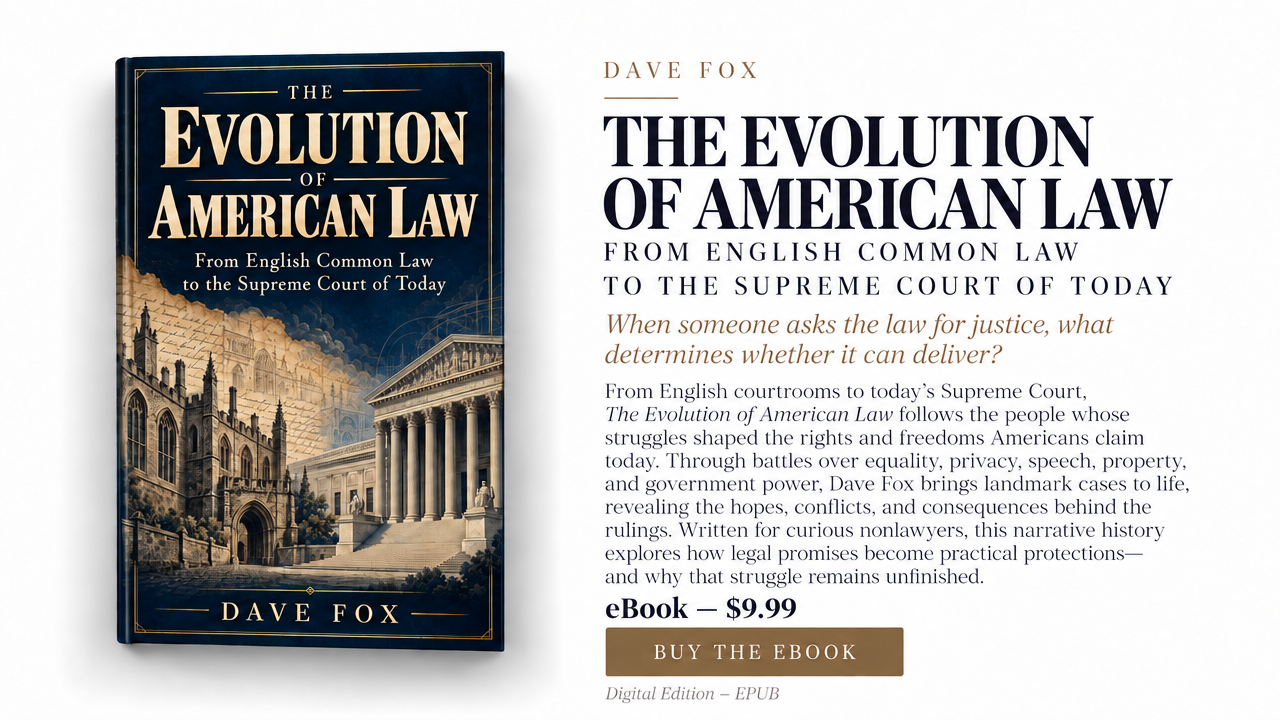
"The Evolution of American Law" by Dave Fox
Clarence Earl Gideon asked a Florida judge for a lawyer. The judge said no. Gideon defended himself, lost, and was sent to prison. From his cell, he wrote a petition by hand to the United States Supreme Court, and changed American law.
Every right Americans take for granted has a history like his: a person who asked the law for help, an inherited rule that stood in the way, and the long work of turning a principle on paper into something an ordinary person could actually use.
The Evolution of American Law traces that work from its roots in English common law to the decisions of today’s Supreme Court. Written for curious readers rather than lawyers, it explains how precedent, courts, constitutions, and remedies really function, and why the answer to “What does the law say?” so often depends on who is asking, which court can hear the claim, and what that court has the power to do.
The story begins in England, where judges built the common law case by case and where John Entick, a writer whose home was searched for hours by the king’s messengers, sued and helped set limits on government searches. It crosses to America, where those inherited practices met written constitutions, divided governments, and fierce struggles over who belonged within the community of rights. In Philadelphia, Richard Allen and Absalom Jones walked out of a church that had sent Black worshippers to its gallery and built institutions of their own. During the First World War, the convictions of antiwar pamphleteers gave the nation the phrase “clear and present danger.” In the age of industry, Ida Tarbell’s investigation of Standard Oil exposed how economic power could outgrow the law’s limits.
Across four parts and twenty-four chapters, the book moves from the structure of government, including the rule of law, judicial review, separated powers, and federalism, through equality, due process, privacy, speech, religion, policing, criminal trials, and punishment. It then turns to property, contracts, civil wrongs, corporations, labor, and family before closing with citizenship, tribal sovereignty, voting rights, and the power to hold government accountable.
The history runs right up to the present. Along the way, the book examines the Supreme Court’s 2026 decisions on presidential removal power, the independence of the Federal Reserve, birthright citizenship, and digital privacy, and follows the litigation and government action that continued after each ruling, because a court’s decision is rarely the end of the story.
Carefully sourced, with extensive notes and suggestions for further reading, and current through October 2026, this book does not tell you what to conclude about today’s legal battles. It gives you the history to understand them: what earlier courts actually decided, what changed, and what remains unsettled.
Gideon won his case. At his retrial, with a lawyer beside him, the jury found him not guilty. The Evolution of American Law is the story of how a promise becomes a right a person can use, and why the distance between the two still matters.