
The Written God by Dave Fox
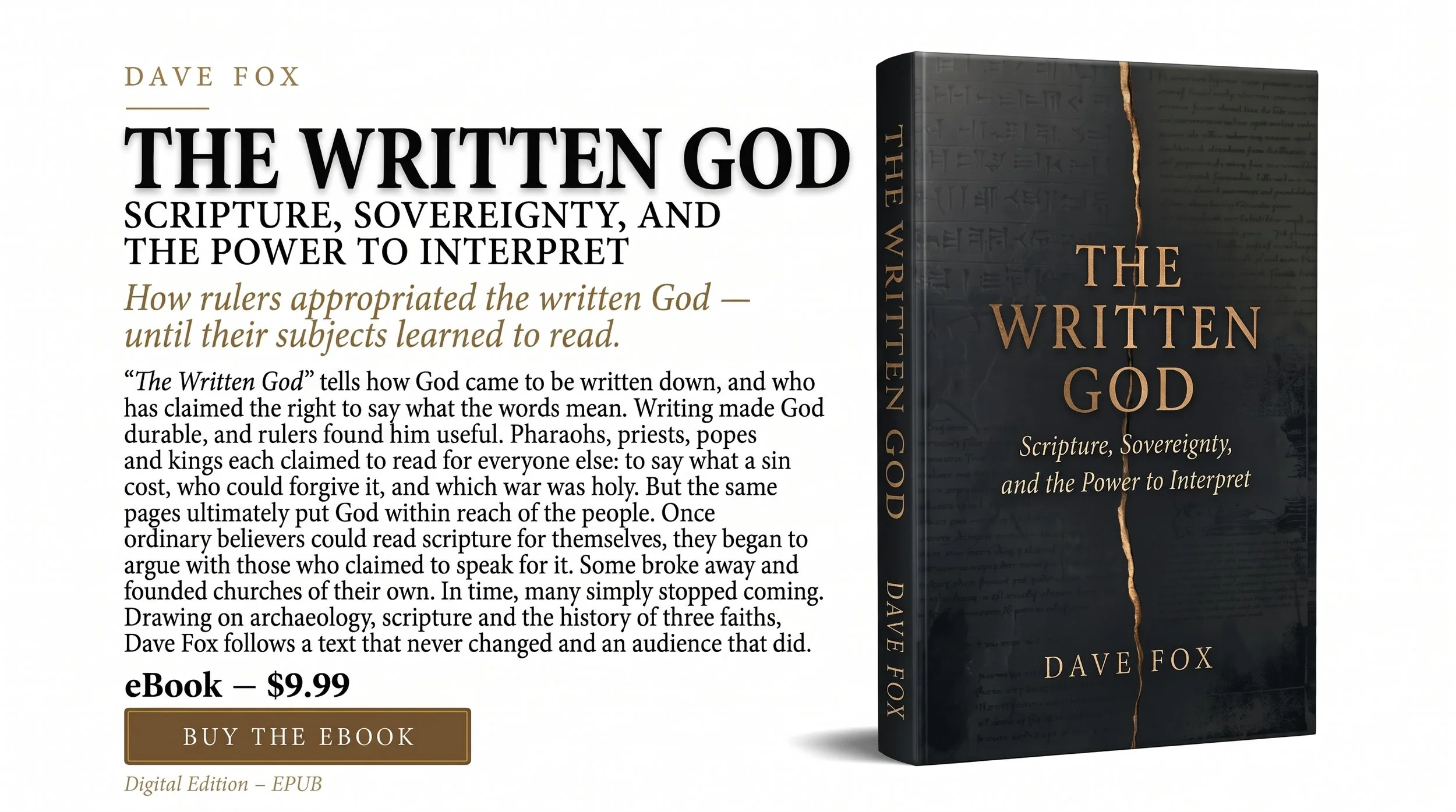
The Written God by Dave Fox
How rulers appropriated the written God, until their subjects learned to read.
In the 1956 film The Ten Commandments, Pharaoh settles every question with a single formula: “So let it be written, so let it be done.” Hollywood invented the line, but the idea behind it is as old as writing itself. A king whose words were written down could make them outlast him. A god whose words were written down could be carried, copied, quoted and claimed.
The Written God is the story of what happened when God became a text.
It begins before scripture, with the first human burials and with gods that people remembered through ritual and song. It moves to the clay tablets of Mesopotamia, where kings first issued their laws in the name of heaven. It stops at a tablet dug up in southern Turkey that bound a whole people to an Assyrian king, and whose language echoes the Book of Deuteronomy. It follows the rise of one God who demanded exclusive loyalty, the “book of the law” found in the Temple at Jerusalem that gave a king his program of reform, and that God’s survival through the defeat and exile of his people.
Writing made God durable, and rulers found him useful. When sin came to be imagined as a debt, someone had to keep the books. Irish monks drew up price lists for penance. A pope offered warriors a journey to Jerusalem in place of all penance. An English king had himself placed on the title page of the Bible, handing down the Word to his bishops. Another told Parliament that kings are rightly called gods. Across Judaism, Christianity and Islam, custodians of the text decided who could read it, in what language, and what it meant.
But a written God is a God anyone can read. A sixteenth-century miller in northern Italy read the Bible for himself and argued with the Inquisition about what it said. Enslaved Christians in America heard Paul’s command to obey their masters, and took up Moses and the Exodus instead. In Ireland, churches that were full within living memory now stand half empty. And artificial intelligence now offers every reader a private interpreter, available at any hour and answerable to no congregation.
Drawing on archaeology, the scriptures themselves, and the history of three faiths, Dave Fox shows that the long struggle over scripture has rarely been about the words on the page. For the most part the words stayed the same. What changed was who was allowed to read them, and who had the authority to say what they meant.
Told with a storyteller’s eye and a historian’s care, The Written God is for anyone who has wondered how holy books came to hold such power, and why that power never stayed where kings tried to keep it.
The text remains. The audience changes.